LogoSyllabus
A Digital Library · Est. 2026

Syllabus

every article,
a private tutorial.

Clear diagrams. Patient pacing. That rare gift of making complex ideas feel inevitable — for graduate students, certification candidates, and homeschooling parents building something real.

Table of Contents
62 essays

"The articles here are what lecture notes aspire to be — organized around understanding rather than coverage."

— PhD candidate, Sociology · Stanford

Scroll
I.
Collection One

Thesis Architecture

Before you write a word, you need to know where you are. These essays build the scaffold.

14 essays in this collection
Stack of books and handwritten notes on a research desk
Thesis Architecture7 min read

Building Your Literature Review from the Outside In

"Start with the map. The territory will reveal itself."

Why chronological surveys fail and how thematic clustering produces reviews that actually argue something.

Person writing carefully in a notebook with a pen, focused and deliberate
Thesis Architecture6 min read

The Problem Statement That Does Real Work

"A vague problem produces a vague thesis."

Three diagnostic questions that reveal whether your problem statement is earning its place in Chapter One.

Conceptual diagram drawn on whiteboard showing interconnected research nodes
Thesis Architecture11 min read

Mapping Your Theoretical Framework Before You Write It

"Theory is the lens. Know what it distorts."

A visual mapping exercise that forces clarity about which theoretical commitments you're making and why.

End of Collection I

Ten more essays waiting in the archive.

Open the Next Chapter
I → II
The foundation is laid. Now the real test: translating what you've read into what you can prove.— Editor's Note
II.
Collection Two

Exam Strategy

For the certification candidate at the kitchen table at 11 p.m. These guides are written for you.

11 guides in this collection
Student studying with flashcards and notes spread on a desk under warm lamp light
Exam Strategy8 min read

Active Recall Over Passive Review: The Evidence

Forgetting is not failure. It is the mechanism.

Why rereading your notes is one of the least efficient study strategies, and what the cognitive science literature says to do instead.

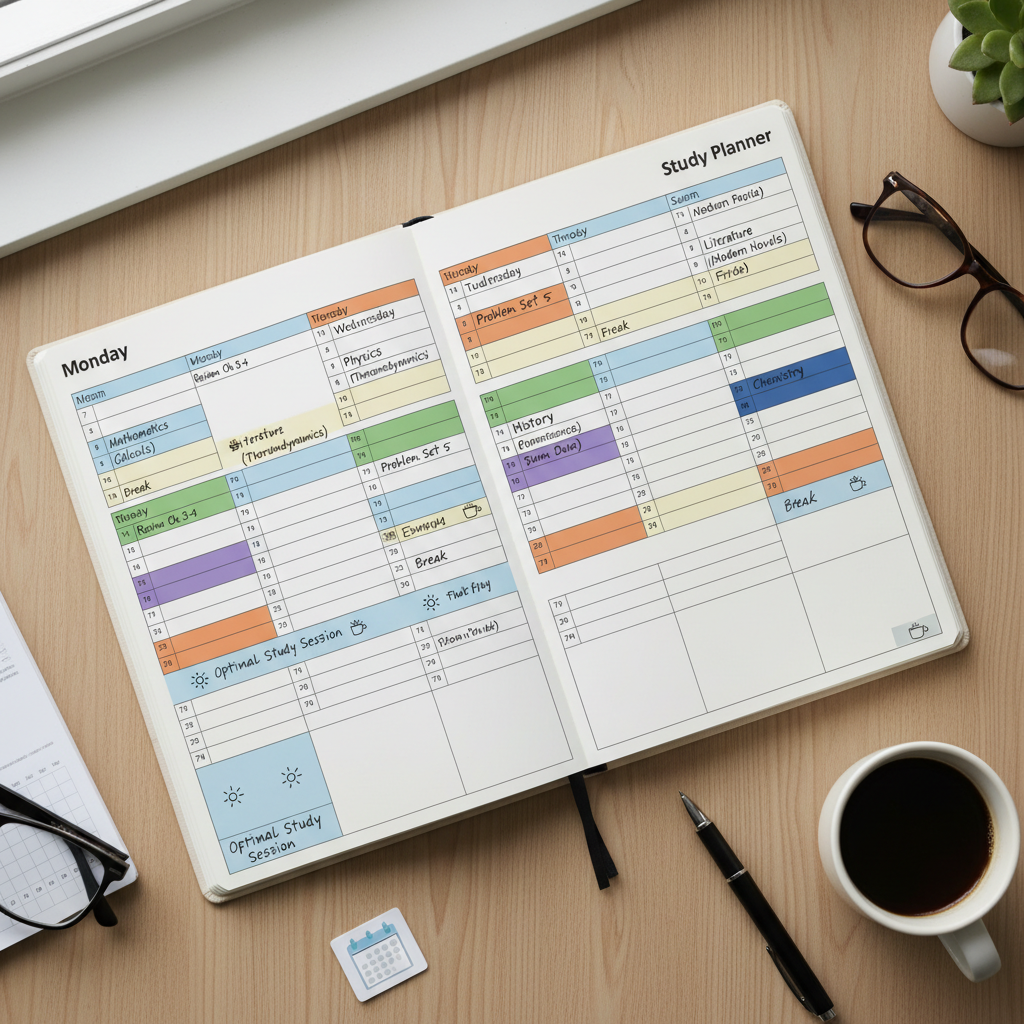
Calendar planner open on a desk with color-coded study schedule entries
Exam Strategy10 min read

The Spacing Effect: How to Build a Revision Calendar That Works

"Space your practice. Let forgetting do its job."

A practical scheduling framework based on spaced repetition, with worked examples for professional certification timelines of 30, 60, and 90 days.

Person sitting calmly at a desk with eyes closed, practicing mindful breathing
Exam Strategy7 min read

Diagnosing Exam Anxiety: What Your Nervous System is Actually Doing

"Anxiety is information. Learn to read it."

A physiological and psychological breakdown of test anxiety, with specific interventions for the night before, the morning of, and the first five minutes in the room.

End of Collection II

Eight more exam guides in the archive.

Open the Next Chapter
Reader Marginalia

Notes left in the margins

What readers write when they finish an essay. Unedited.

On: Mapping Your Theoretical Framework
"I read the theoretical framework essay at 1 a.m. before my proposal defense and it reorganized everything I thought I understood about my own chapter. I passed."
Priya VenkataramanPhD Candidate, Educational PsychologyUniversity of Michigan
On: Active Recall Over Passive Review
"Studying for the PMP after a decade in project management felt impossible. The active recall guide was the first study resource that actually explained the science behind why I kept forgetting things."
James OkonkwoSenior Project ManagerCareer switcher, Chicago
On: Research Methods collection
"I use these articles to build reading lists for my homeschool co-op. The research methods series gave me the vocabulary to teach my 14-year-old how to evaluate sources. Nothing else I found was written at this level."
Sarah BrennanHomeschooling parentPortland, Oregon
On: Building Your Literature Review
"The literature review essay saved my thesis. I had written a 40-page chronological survey that said nothing. I restructured it in two days using the thematic clustering method described here."
Tomás Reyes-CastilloMA Student, SociologyUniversidad Autónoma de Madrid
62Essays publishedacross 5 collections
2.4kWeekly readersand growing
9.2Avg. minutes readper article
94%Return ratereaders who come back
IV.
Collection Four

Study Systems

Advanced essays for readers who've moved past the basics and need systems that scale.

16 guides in this collection
Study Systems14 min readAdvanced

Designing Mixed-Methods Studies: When Qual Meets Quant

"Integration is not addition. It is a design decision."

The most common mistake in mixed-methods research is treating qualitative and quantitative strands as parallel tracks. This essay explains convergent, explanatory, and exploratory designs — and when to use each.

Research data charts and qualitative notes side by side on a research desk
Index cards and handwritten notes organized in a systematic grid pattern
Study Systems11 min read

The Zettelkasten Method, Adapted for Academic Research

"Notes that talk to each other think for you."

How to build a permanent note system that actually generates ideas rather than just storing them.

Clean minimal workspace with laptop and single notebook, no distractions
Study Systems8 min read

Deep Work for Part-Time Students: Protecting Concentration in a Fragmented Day

"Depth requires defense. Guard it."

Practical protocols for achieving two to four hours of focused academic work within a full working day.

The archive continues

Forty-nine more essays,
waiting for you.

Curriculum Design. Research Methods. Advanced Thesis. The deeper you go, the more specific it gets — and the more useful.

Get the weekly reading list —one email, five essays, every Sunday.